
How to Cut Your Weekly Wage Bill Without Docking Your Lads' Hours
You pay your lads for the hours they work. That is fair. But look at your wage bill each week and ask: could you prove every hour on it?
On most scaffolding firms I have worked with, you can't. Hours get guessed on a Friday, or copied from last week. Nobody is lying. It just adds up, and you pay for it.
This post is about fixing that without cutting anyone's hours and without a row. Pay what was worked, and know what was worked. That is why I built ClockPilot. Your lads clock in and out on WhatsApp, so the hours are written down on the day. Try it free for 7 days.
Where the money leaks
It is rarely one big thing. It is small things, every week:
- Hours written up on a Friday from memory
- A lad leaves early and is still paid the full shift
- A day copied over from last week
- A lad marked in on a day they were off
None of that needs anyone to cheat. But if the hours are not written down on the day, someone has to guess. And a guess is usually generous.
What happened to me
I have had it where the office sent me my hours for the week and had me down for a Wednesday I was not in. I told them and they fixed it. If I had said nothing, I would have been paid a full day I never worked.
I am not saying anyone did it on purpose. There was no record of the day, so they filled it in. That is the point. If it can happen to me, it can happen to anyone on your books. With a clock-in, that Wednesday would have been empty, and nobody would have had to guess.
What you can and can't do
If you told a lad to be on site, they are owed the pay for that time. GOV.UK says time at the workplace counts when you require the worker to be available for work, even if you give them no work for that time.
You also can't take money off wages just because you think they were slow. Acas says an employer can deduct only for set reasons: the law (like tax), what the contract allows, an earlier overpayment, or something the worker agreed to in writing beforehand. Poor work is not on that list. A deduction also normally can't take pay below the minimum wage (GOV.UK).
This applies to employed workers. If your lads are self-employed under CIS, the rules are different, and you should check with your accountant.
So the fix is not cutting hours. It is knowing where the hours go, and managing the job.
What to do when the hours look too high
Writing hours down won't stop a lad messing about. But it shows you where the time goes.
- Every lad records their start and finish on the day, with the job.
- Add up the hours for each job. Now you can see which jobs made money and which lost it.
- Find out why. It could be late materials, waiting on another trade, or slow work.
- If it is the lad, talk to them with the numbers in front of you.
It works on paper, but paper gets lost and written up late. Here is how ClockPilot does it. You set the rota, and ClockPilot does the chasing. At start time, each lad gets a WhatsApp message with the job address. They tap "Send your current location" and they are clocked in. At finish time, they get another message to clock out. Every clock-in and clock-out is saved on your Google Sheet, and you can see who is on site right now. Nobody has to write anything up or chase anyone.
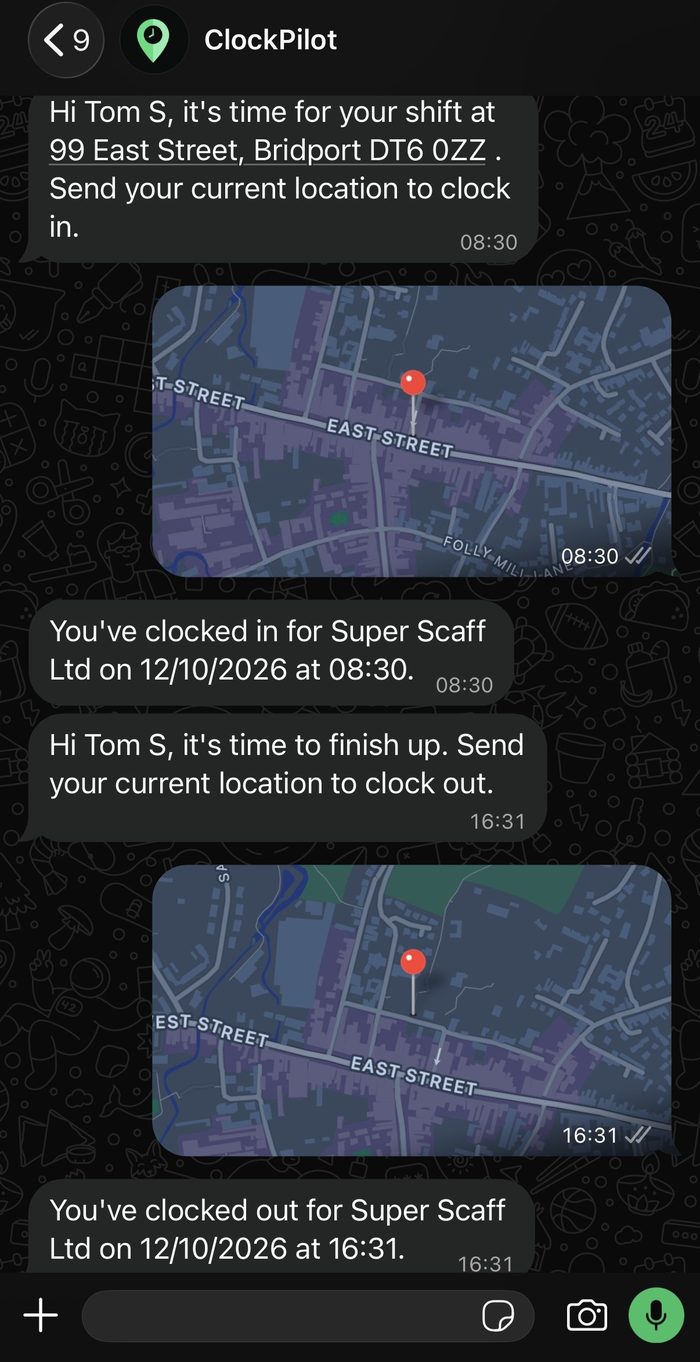
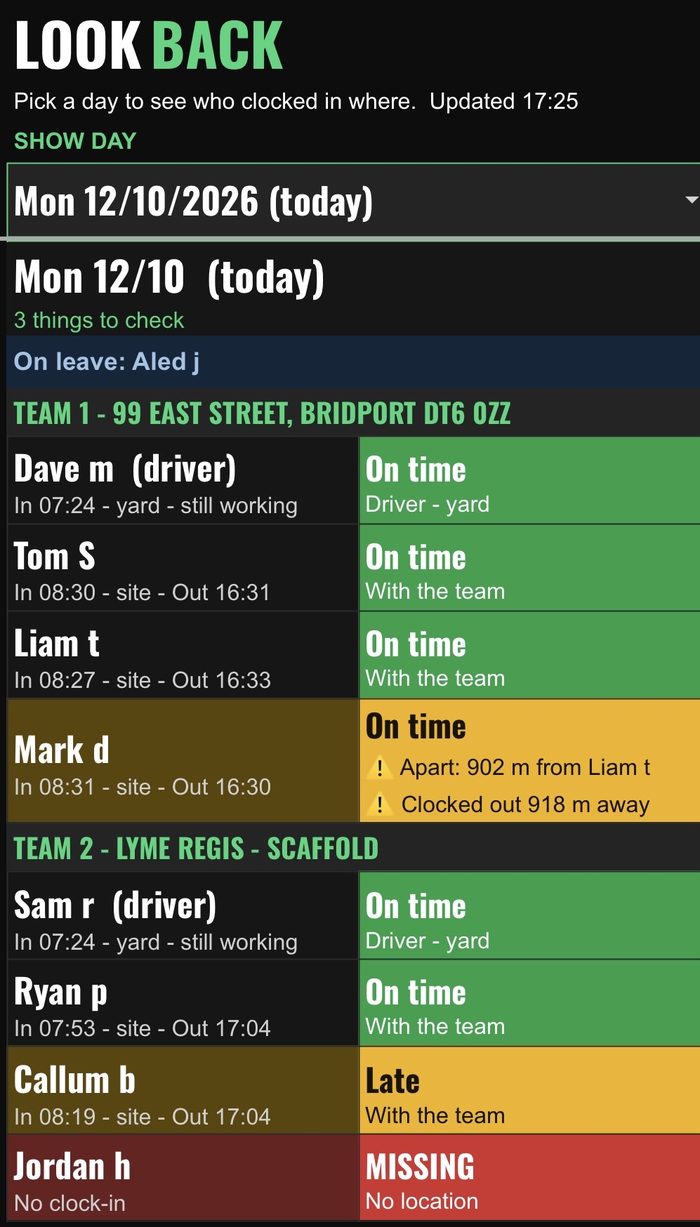
In my experience, clock-in apps fail on site. The lads have to download them, they forget their passwords, and the apps keep breaking. Getting started is where most of them fall over. ClockPilot runs in WhatsApp, which the lads already use. There is no app to download and no password to forget, so getting your crew started is simple.
Also worth a read: how to run a construction firm on WhatsApp, with groups, broadcast lists and communities.
Want to try it on your crew?
There is a 7-day free trial, and I will set it up for you. Message me on WhatsApp or ring 07466 449328 and we will get your lads on it.
Message me on WhatsApp