
Timesheets for Scaffolders: How to Track Hours Without Chasing the Lads
The fix for wrong scaffolding timesheets is to record hours when the work starts and finishes, not from memory the day before payday.
Why scaffolding timesheets go wrong
Scaffolding is one of the hardest trades to keep timesheets for, because the work moves. Several teams start the day at different sites, a crew can strike one job and be back at the yard before lunch, and nobody is logging the times as they happen. Often there is no clear record written down of who was where.
The same few things cause most of the errors:
- Hours written from memory. Lads write or text their hours at the end of the week, so Monday's start time is a guess.
- Several jobs in one day. All the time gets put on one job, so you never learn what each job really cost.
- Travel and yard time. Nobody agrees whether it counts, so it gets argued about at pay time.
- Lost or soggy paper. Sheets get left in the van, ruined by rain or never handed in.
- Chasing. The gaffer or the office spends the day before payday chasing sheets instead of planning work.
My boss once messaged me on WhatsApp to question my hours. I was working on my own, with nobody else on the team to back me up. The photo I took showed where I was and what time it was, and that proved my hours. It also proved the job was finished. Without it, I could have been docked.
The result is the same each time: someone's pay is wrong, or the firm can't tell what a job cost.
What a scaffolding timesheet needs to capture
A useful timesheet answers four questions: who worked, where, when, and at what rate. Anything beyond that can wait until it starts causing arguments.
- Name and date.
- Site or job. The address or job name for each job, not one line per day.
- Start and finish times. The actual times, not rounded to the nearest hour.
- Breaks. Paid or unpaid, agreed in advance.
- Travel and yard time. Decide your rule once and write it down.
- Overtime, Saturday and Sunday hours. Recorded separately if they pay different rates.
- Grade or rate. Labourer, Part 1, Part 2 or Advanced, if pay depends on it.
- What was done, and what went wrong. When you finish a job, write down the time, what you did and anything that went wrong. A short line is enough.
If you pay a day rate, you still want the hours recorded. They show how long jobs really take, and they are your evidence if hours are ever questioned.
Paper, spreadsheet, app or WhatsApp: which suits a scaffolding crew?
Paper costs nothing to start and is the least accurate. For a small crew, WhatsApp is the digital option that asks the least of the lads.
| Method | How hours get recorded | Main weakness | Fits best |
|---|---|---|---|
| Paper timesheet | Handwritten, handed in weekly | Filled in from memory, lost or illegible | One-off jobs, very small crews |
| Spreadsheet | Someone types hours in | Retyping errors, and someone has to do it | Firms with an office person |
| Clock-in or timesheet app | Worker taps in the app | Install, logins and training for every lad | Larger firms with admin staff |
| Worker taps send location in WhatsApp | Needs phone signal, and WhatsApp on every phone | Small crews already using WhatsApp |
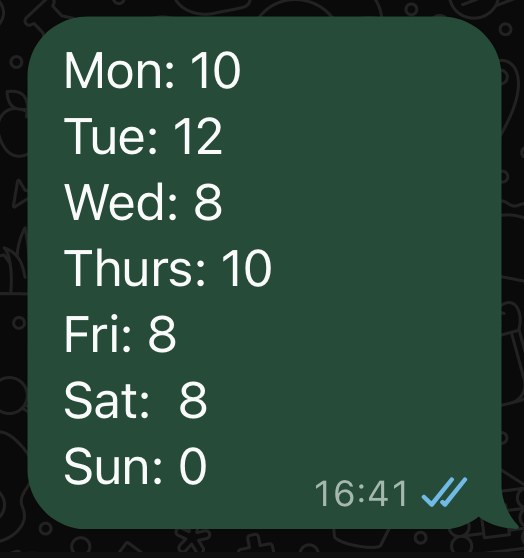
In practice, most lads I know just WhatsApp their hours at the end of the week, and I don't really do timesheets any more. Some still do. The trouble is that those hours are still from memory, and someone has to read the messages and add them up.
If your crew already uses WhatsApp for job details and lifts, logging hours there needs the least learning. There is no new app to install and no password to forget. ClockPilot is built for exactly this.
How clocking in on WhatsApp works
With ClockPilot, a crew clocks in and out by sending a WhatsApp message to one number, so hours are logged without a new app or a paper sheet.
- Clock in. At shift time ClockPilot messages the lad on WhatsApp with the site address. He taps "Send your current location" to drop a pin, and ClockPilot replies to confirm the time he clocked in.
- Clock out. He does the same when he finishes.
- Hours are logged. ClockPilot checks each pin against the roster you set up on the ClockPilot website, and the times land in a Google Sheet you can open.
- You check and pay. The week's hours are already there before payday, so there is no paper to chase.
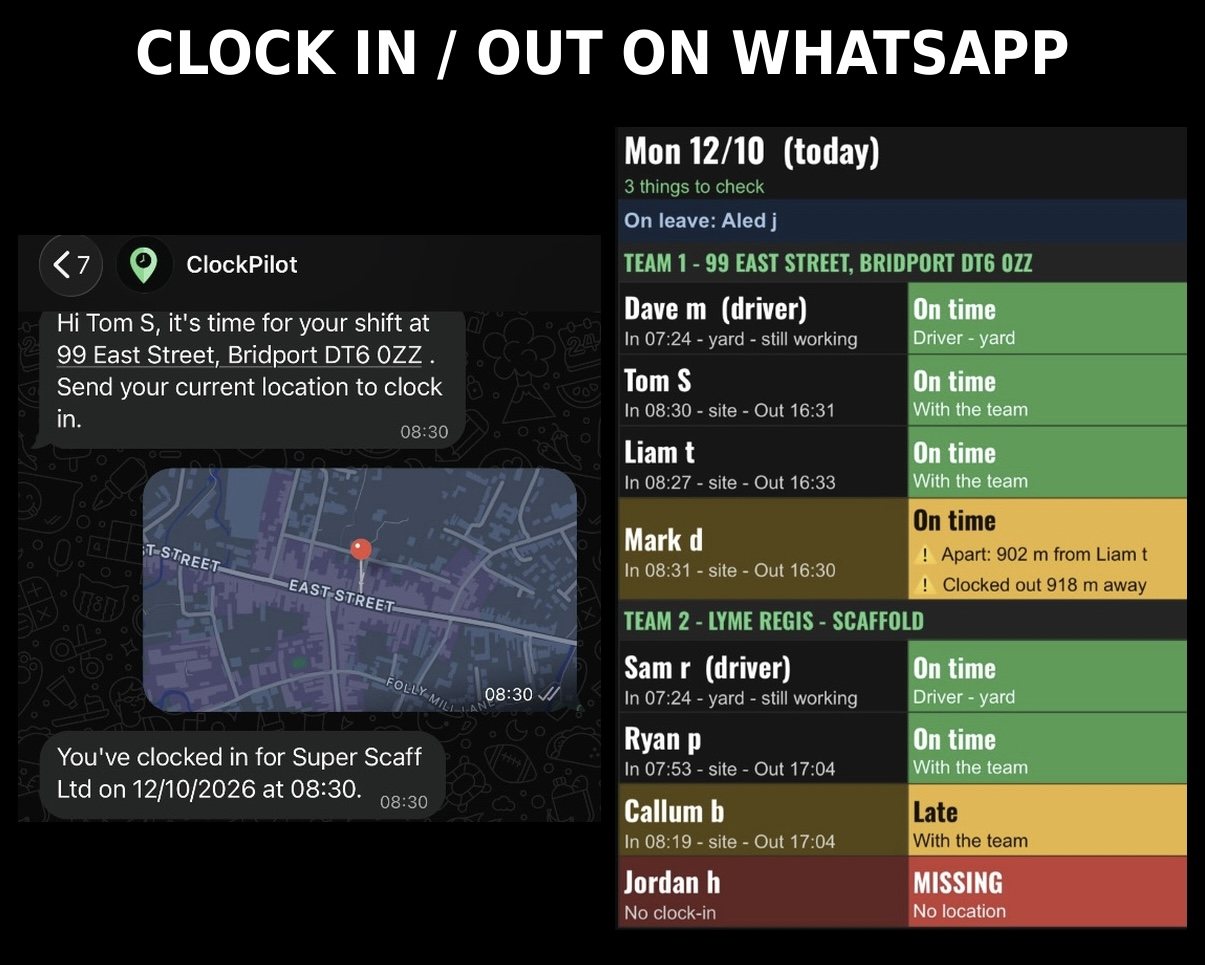
On your phone, the Look Back view shows each team, and who is on time, late or missing. It also flags a lad who clocks in or out a long way from the rest of his team, so you can spot a problem the same day.
That's the same idea as the photo that proved my hours: a time and a place, recorded when it happens instead of remembered later.
It won't suit every firm. Everyone on the crew needs WhatsApp on their phone, location switched on and a bit of signal when they clock in. If your lads already use WhatsApp for the job, that is usually an easy ask.
Want your crew clocking in like this? Ring or message me on 07466 449328 and I'll set up your ClockPilot WhatsApp button for you.
What records UK scaffolding firms need to keep
You don't have to log every hour of every day by law, but you do have to keep records that prove working time limits and pay rules are met, and some of them must be kept for six years.
| Record | What it proves | Keep for |
|---|---|---|
| Working time records | Nobody is over the 48-hour weekly average (unless opted out), plus night work and young worker limits | 2 years from when made |
| National Minimum Wage records | Pay was at least the minimum for the hours worked | 6 years |
| Holiday and holiday pay records | Holiday entitlement and holiday pay were calculated correctly | 6 years, new duty from 6 April 2026 |
| PAYE payroll records | Tax and National Insurance were worked out correctly | 3 years after the end of the tax year |
| CIS payment records (subcontractors) | What you paid each subcontractor, and any deductions made | 3 years after the end of the tax year |
What I see go wrong most is when the supervisor or manager is on holiday. With nobody checking, a lad can put himself down for a full day he wasn't in, and if nothing was written down for that day, the boss has to take his word for it and pay the hours. Not every lad is straight about hours, and a record made on the day, with the time and place, takes the argument away.
A few points that matter on site:
- Timesheets are the easiest way to hold all of this. Acas says employers don't need to record every daily hour. In practice, start and finish times are what the working time, minimum wage and holiday records are built from.
- The rules cover workers, not only employees. Acas lists agency, casual and seasonal workers as covered. Whether a lad is a worker or genuinely self-employed depends on how he is engaged, so check if you're unsure.
- On building sites, the Health and Safety Executive deals with working time record complaints, according to Acas.
What if your lads are CIS and self-employed? Plenty of scaffolders are paid under the Construction Industry Scheme as self-employed subcontractors. For someone who is genuinely self-employed, the working time, minimum wage and holiday rules above don't apply. You still have to keep CIS records: the gross amount of each payment and any deductions, for at least 3 years after the end of the tax year. Whether a lad really is self-employed depends on how he works, not what his paperwork says. A lad who works set hours under your direction may count as a worker, and then those rules do apply. If you're unsure, check with HMRC or Acas.
Either way, a record of who was on site, when and where is useful. It's your evidence if a lad claims a day he wasn't in, or if you're ever asked to show how you worked out a payment.
This is a general guide, not legal advice. Check GOV.UK and Acas before you set your own retention policy.
Day rate or hourly: track the hours either way
Scaffolding is often paid by the day. One agency listing in the West Midlands in July 2026 offered £170 to £180 a day for a Part 2 and £110 to £120 for a labourer.
A day rate is simple to pay, but it hides the hours. Record them anyway, for four reasons:
- Minimum wage. If he's a worker, a day rate still has to cover at least the minimum wage for the time actually worked, and the records exist to prove that. Long days are where it can slip.
- Job costing. Hours show what each job really cost you, which is how you price the next one.
- Disputes. Start and finish times give you something to point to when a lad says he was there until six.
- Mixed pay. If weekend or overtime hours are paid by the hour, you need the hours anyway.
How lads get paid depends on the company they work for and the contract they're on. Some are on a day rate and some are paid by the hour. Either way, the recorded hours are what you fall back on if pay is ever questioned.
Scaffolding timesheets: common questions
Do scaffolding firms have to keep timesheets in the UK?
No rule says "keep timesheets" by name. You do have to keep working time, minimum wage and holiday records, and timesheets are the simplest way to hold the hours behind all three.
How long should I keep scaffolders' timesheets?
Six years covers the longest requirement in the table above, which is minimum wage and holiday records. Working time records must be kept for two years.
How do I track a crew's hours across several sites in one day?
Have each lad record a start and finish for each site, not one entry per day. That gives you accurate job costs and a clear record of travel between sites.
Can scaffolders clock in on WhatsApp?
Yes. ClockPilot lets a crew clock in and out by sending a WhatsApp message, with no separate app to install.
Does paying a day rate mean I don't need timesheets?
No. For a worker, a day rate still has to meet the minimum wage for the hours worked, and recorded hours are what show it.
Do CIS self-employed scaffolders need timesheets?
Not for the minimum wage, working time or holiday rules, which cover workers and not the genuinely self-employed. You still have to keep CIS payment records for at least 3 years after the end of the tax year. A record of start and finish times is still the best evidence of who was on site and when.
Also worth a read: how to run a construction firm on WhatsApp, with groups, broadcast lists and communities.
Want to see it on your crew?
Start a 7-day free trial. Message me on WhatsApp or ring 07466 449328 and I'll set it up for you, free.
Message me on WhatsApp